
How an AI Detection Tool Triggered a Civil War on Substack
The irritating tells of an AI-written text, why Pangram could be a bad idea, and whether readers care about origin at all.


In the Flash is a reader-supported publication about intent and creativity in photography. To join the conversation
Photographers have spent the past couple of years bemoaning AI as the biggest Armageddon since Instagram. I don’t share many of the concerns regarding AI being an existential threat to photography, for reasons I’ll get into in a later post, and have been watching the panic from the sidelines while training AI to be my photo editor (it’s shockingly effective).
Meanwhile, writing, not photography, has been inundated with AI, creating a problem that has become both insidious and all-pervasive. At first, email blasts from various photography platforms started having the same smooth, generic voice. Soon after, I was spotting AI-written music reviews and photography texts across many different publications. Even my Japanese rice shop replaced older descriptions with AI-sounding constructions. It is not at all surprising, then, that AI flooded Substack.
The amount of AI-written newsletters and notes on the platform has exploded to a point that Substack introduced Pangram, AI-detection software, and in doing so, triggered a civil war. The pushback to Pangram has been vehement, with writers comparing its implementation to a witch hunt and a moral purity test. The fact that many of such lamentations carry the symptoms of AI writing doesn’t come as a surprise. What I didn’t expect was the amount of comments supporting such a line of thinking. It turns out that, far from being outraged at the amount of AI revealed in writers’ newsletters, enough readers are still happy to read them and neither want to know, nor care, how the texts came to be.
Professional photographers and writers tend to discuss AI as though the argument belongs entirely to us. We argue about creativity, skill and labor, while considering the value of a distinct human voice to be instinctual and universal. But those who write and photograph for a living make up a tiny subgroup compared to the sizeship of the general audience, and that audience is turning out to be a wildcard when it comes to authorship and AI. The last week on Substack showed me that while I’m allergic to AI writing, many hobbyist writers and readers don’t give a damn.
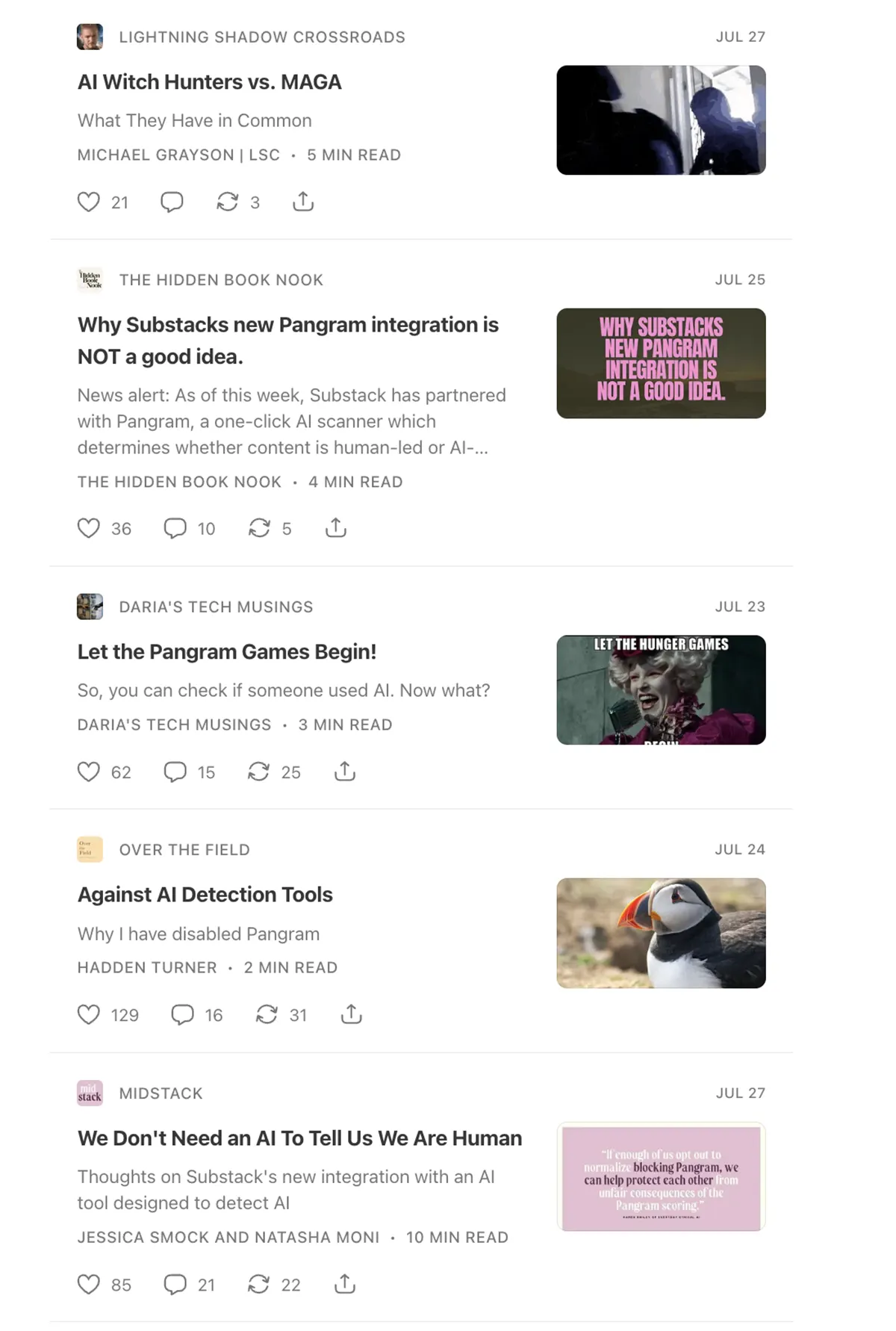
One of the stranger defences of AI writing I keep seeing is that nonfiction exists primarily to convey information and therefore has less of a need for a human voice or distinctive prose. That a writer would indulge in such a self-sabotaging argument is both preposterous and a bit sad. Reviews, criticism, opinion essays or cultural and news pieces are only as good as the person writing them, because while the information is available to many, only a few can condense and structure it in a way that’s interesting and relatable to a large number of people. Without the unique personal voice, like the self-deprecating humour of Gary Shteyngart, the evocative music writing of Philip Sherburne, the incisive cultural wit of Helen Lewis, and the satirical prose of Mark Leibovich, information becomes a Wikipedia article.
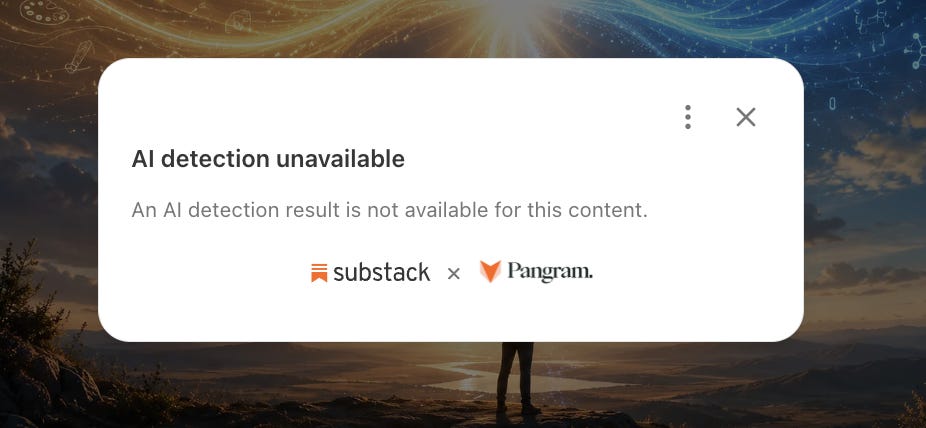
Many writers protesting the use of Pangram are also disabling it, making AI detection unavailable on their posts. There is little need for that. Just the first few lines carry the unmistakeable symptoms of the digital voice. The articles, though long and wordy, have low information density, repeating the same ideas over and over again while reinforcing them with inflated emotional language. Sweeping declarative statements, bolded words and stand-alone sentences, an overabundance of metaphors, and the infamous “It’s not this, it’s that” construction — all amount to badly written articles with big egos. There are also em-dashes, but I am taking those back.
This is what happened when I asked AI to write out my ideas. If this sounds familiar, it’s because you’ve read this construction over and over again. It is impossible to escape the AI voice, no matter how much personal information or ideas you pack into it.
Here’s the thing about AI writing: it isn’t just bad—it’s exhausting.
Every sentence arrives perfectly balanced, perfectly hedged, perfectly forgettable. It’s not that the prose is wrong. It’s that the prose is nowhere. Just an endless conveyor belt of competence.
And that’s the real problem.
Because reading isn’t just about information — it’s about connection. When you read a person, you’re tracking a mind: its obsessions, its blind spots, its weird little grudges. When you read a model, you’re tracking a consensus. It has read everything and noticed nothing.
The result? Text that’s easy to read and impossible to remember.
And that, ultimately, is what we lose.
A few months ago, I pulled out of a book project after the editor sent me drafts about two of my photo series, Meatpacking and Dark City, supposedly put together by a writer but bearing the hallmarks of AI. The Dark City draft was a reshuffled version of my artist statement, recycling exact phrases in odd combinations, while the Meatpacking text had nothing to do with the series and instead borrowed ideas from Untag This Photo, an entirely different project, with the confident confusion of an AI hallucination. Both drafts had bolded words, filler adjectives, and sweeping generic claims. When asked about it, the editor denied any AI involvement, and we parted on less than jovial terms.
Though I ran the drafts through five different AI detectors, and every one came back positive, I now recognize that there is still a chance that they were human-written. This style of writing has become so prevalent that it has created a boomerang effect: writers who are still developing their voices have started to internalize the same omnipresent AI tropes. While that makes it impossible to prove that the drafts, or any writing, are 100% AI-made, it doesn’t change the larger problem that they were poorly constructed.
I thought back to this incident because it illuminates the one problem Pangram may never be able to solve — accuracy. If human writing is beginning to echo AI constructions, it would be impossible to distinguish one from the other, and the chance of false positives will outweigh the tool’s proposed usefulness. Then Pangram could indeed become a witch hunt, one that’s aimed at weak writing.
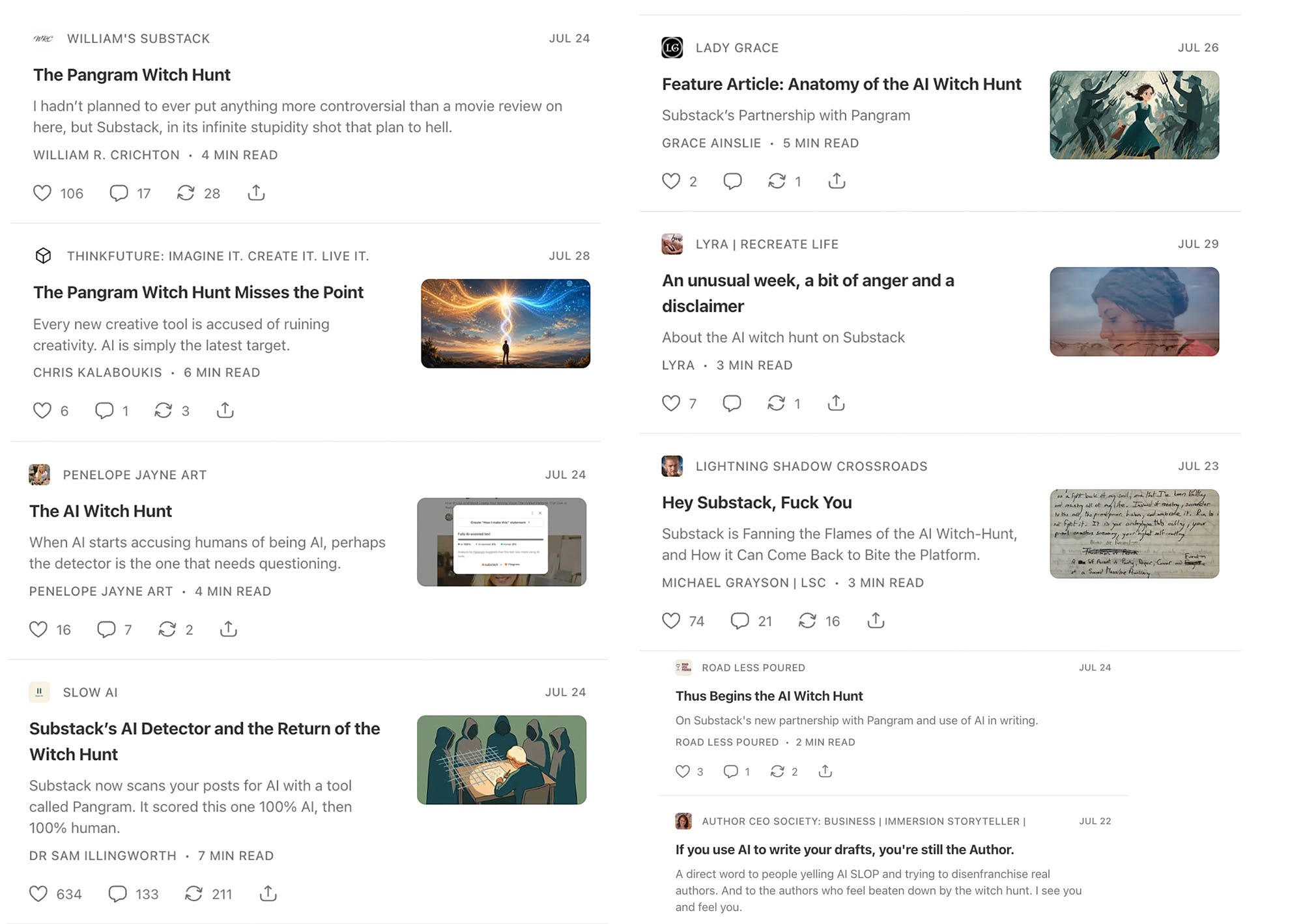
As a reader, I refuse to entertain AI-sounding articles because they are a waste of my time. It take resolve and patience to dedicate my ADD-ridden brain cells to sit with an article. In return, I need it to have an idiosyncratic voice that reveals as much about the writer as it provides me with information. Which brings me to another bizarre AI-supporting argument circulating on Substack, that Pangram discriminates against writers whose first language is not English, neurodivergent writers who use AI to organize their thoughts, and, inexplicably, women. As someone encompassing all such multitudes, I call bullshit.
By taking the easier way out, writers are sabotaging their own chances of becoming good and developing a style. Five years ago, I couldn’t put a caption together, and it would take me several hours and a Xanax to write a few sentences for photo contests or magazine assignments. To start this newsletter, I had to put myself through a personal writing boot camp. Five years later, I am still honing my voice. Turns of phrase, rhythm, way of structuring an argument, and my odd and sometimes awkward use of words that I dubbed “Dina-isms” have all been congealing together to form a style. This development has been a slow, painful, but immensely rewarding process. All of it would have been impossible if I had used the AI crutch from the beginning, since it seduces the writer into mistaking productivity for progress.
AI does have its place in writing. With careful tuning it can become an effective editor. I run my drafts through it to handle all the necessary housekeeping: locating logical inconsistencies in themes and structure, as well as grammar and syntax mistakes. I’ve trained it to be great at that, but alas, AI can’t write. In fact, I’ve observed it get worse at writing, perhaps because it keeps absorbing AI-generated texts from public platforms, thus cannibalizing itself.
I have gone through dozens of Substack articles condemning Pangram as a witch hunt while insisting that AI is a legitimate tool that doesn’t devalue ideas or make the writing any less unique and human. They all read exactly the same. Still, hundreds of comments supported such arguments, which made me realize that instead of bringing order to Substack, Pangram inadvertently raised an uncomfortable question of whether readers care about origin in the first place.
The surprising answer seems to be, not everyone, not always, and not really. Plenty of readers on Substack and beyond enjoy reading AI-generated non-fiction, or even fiction. What irritates me about AI writing is its hollow format, empty posturing and clichéd statements, but as Jeffrey "The Dude" Lebowski famously said,
“Yeah, well, you know, that’s just, like, your opinion, man.”
The readers have theirs, and that makes Pangram muddier.
While my attitude towards bad writing is unambiguous, I remain conflicted about Pangram because I am not sure what problem the software solves. Does it educate, shame, or punish? AI detection is useful in academic settings in which the process of learning how to formulate and write out arguments and ideas is more important than the result. But on a newsletter platform, where readers can judge the writing for themselves regardless of the process, it seems both redundant and invasive.
Readers who care about AI writing can recognize it without a detector. A confirmation of AI use would not change my opinion of an article that’s already convoluted and dull. The reverse also holds. If Pangram flagged a piece I found intelligent and well constructed, I would assume a false positive or a limited use of AI for editing and research. The detector reveals nothing that the writing itself hasn’t already.
Going forward, detection could become less reliable as AI quirks infect human writing at the same time as programs intended to disguise AI writing as human are proliferating on the market. And soon enough, we will end up where we started, relying on our own knowledge and instincts to decide whether a piece has anything worth reading.
Find me on Instagram
I found it interesting that Pangram flagged my post as 💯 Human even though it includes a whole paragraph written by AI. That seems to show that it analyzes context vs just count the # of AI constructions.
“Five years ago, I couldn’t put a caption together, and it would take me several hours and a Xanax to write a few sentences for photo contests or magazine assignments. To start this newsletter, I had to put myself through a personal writing boot camp. Five years later, I am still honing my voice.”
Really? Your writing is so good I keep wishing you’d do more narrative, documentary photography so I could enjoy the reporting and writing as much as the images. But I know, there’s something about a blank page that is terrifying. 😀